
What annoyed you this week?
Complaints often hide the sharpest posts. If it points to a pattern, turn it into a lesson or a contrarian take.


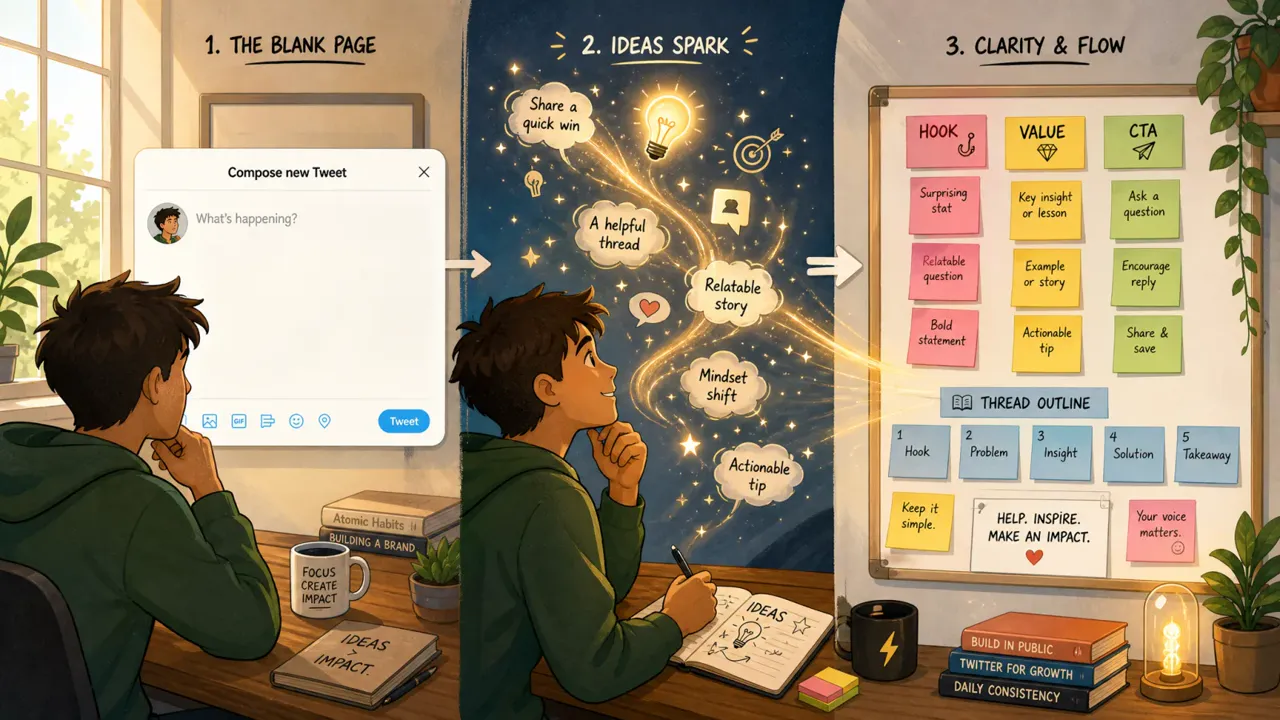
You open X, stare at the compose box, and nothing comes out. It's not a lack of ideas, it's a lack of a framework. Here are 6 proven frameworks and 30 examples to get you unstuck in 5 minutes.
Editorial Note
TwitFlow is built for founders, creators, operators, and indie hackers who want a lighter writing workflow for X/Twitter. Our guides are written by humans, updated regularly, and grounded in product usage, practical examples, and sourced claims.
This guide is maintained as an editorial playbook for ideation, not a trend list. We update examples based on recurring creator workflows and keep each framework tied to practical writing situations that readers can test quickly.
Last reviewed: June 30, 2026. For corrections, feedback, or partnerships, contact hello@twitflow.app.
Pixie Wong leads editorial strategy at TwitFlow, focusing on practical writing workflows for X/Twitter creators. She reviews and updates guides with product-backed examples so readers can apply each framework quickly.
Complaints often hide the sharpest posts. If it points to a pattern, turn it into a lesson or a contrarian take.
Opinion shifts create tension without forcing fake controversy. They work well for retrospectives and tool recs.
If you explained the same point to a teammate, user, or friend more than once, it's strong enough for a public post.
Most "what to tweet" guides give you generic categories like "ask questions." They aren't wrong, but they aren't useful. The real challenge is finding a sharp angle that sounds like you.
The best ideas don't come from brainstorming abstract topics. They come from compressing real work signals: a customer question you answered twice, a bug that taught you something, or a small opinion you changed. This guide helps you find those signals in your own work.
Framework 1
Start with "Most people think X, but actually..." and share a counter-intuitive insight from your experience. It makes people stop scrolling.
Framework 2
What did you try, what happened, what did you learn? Specifics build trust. Vague lessons get ignored; concrete stories get saved.
Framework 3
Share one tool, explain the one problem it solves, and say why you prefer it over the obvious alternative. Low-effort, high-engagement.
Framework 4
Ask something you genuinely don't know the answer to in your domain. Not "what do you think?" but a specific question that invites real opinions.
Framework 5
Pick a number between 3 and 7. State the topic. Deliver the list with no filler. Each point should be a standalone sentence.
Framework 6
Share a small, honest moment about frustration, burnout, or self-doubt. These connect instantly because everyone feels it, but few say it.
A framework becomes useful when you see how it changes the same underlying thought. Here’s one topic turned into three different drafts.
Contrarian Take
Most people think consistency means posting daily. I think it means never disappearing for two weeks because you burned out.
Honest Retrospective
I tried to post daily for a month. The result wasn't growth, it was exhaustion. What finally worked was drafting in batches twice a week.
Open Question
What's more sustainable for you on X: posting every day, or writing 5 drafts in one session and spacing them out?
Enter any topic. Get 5 ready-to-post tweet drafts in 30 seconds. Free, no sign-up, your drafts stay in your browser.
Try the Free AI Tweet Generator →