How Often Should You Tweet in 2026? (Data-Backed Answer)
Last updated: · First published: · 7 min read

Pixie Wong leads editorial strategy at TwitFlow, focusing on practical writing workflows for X/Twitter creators. She reviews and updates guides with product-backed examples so readers can apply each framework quickly.
The short answer
For most creators, 3-5 original tweets per day is the sweet spot - enough to stay visible in the algorithm and build a posting habit, not so many that quality collapses. If you are just starting out, 1-2 per day is fine. Volume only helps after you know which angles land.
What our analysis found
We tracked 200+ active accounts across five categories (founders, marketers, writers, developers, and operators) for 90 days. Each account posted at least 3 times per week and had between 1,000 and 50,000 followers. Here is what the aggregate data showed:
- 1-2 tweets per day: Median engagement rate was 3.4%. Followers growth was slow but steady. Reply rate was highest in this group - the audience has more time to absorb each tweet.
- 3-5 tweets per day: Median engagement rate was 2.9%, but total engagement volume was 2.7x higher than the 1-2 group because of reach compounding. This group grew followers 40% faster on average.
- 6-10 tweets per day: Individual tweet engagement dropped to 1.8% median. Total impressions continued to grow but follower-to-impression ratio weakened - likely because the algorithm distributes reach across more posts.
- 10+ tweets per day: No significant advantage in follower growth for accounts under 50K. Several accounts showed audience fatigue (mute rates estimated from reply pattern drops). This cadence worked only when posting was highly varied in format (threads, short takes, quotes, replies).
The algorithm mechanics
X/Twitter's current ranking system (post-2024 Grok integration) prioritises recency x predicted engagement x relationship depth. What that means practically:
- Recency matters more at low follower count. If you have under 5K followers, posting during peak hours (7-9 AM ET, 12-1 PM ET, 5-7 PM ET) multiplies your organic reach because the algorithm surfaces recent content more readily in low-engagement feeds.
- Predicted engagement is the ceiling. Your historical click-through and reply rates set a credibility floor. If you repeatedly post content that gets ignored, the algorithm gradually throttles your reach. Posting less but consistently landing engagement is better than high volume with low signal.
- Relationship depth compounds over time. People who regularly reply to your posts get more of your content in their feed. This means a tight 500-person engaged audience can drive more growth than a passive 5,000-person following.
Why consistency beats volume
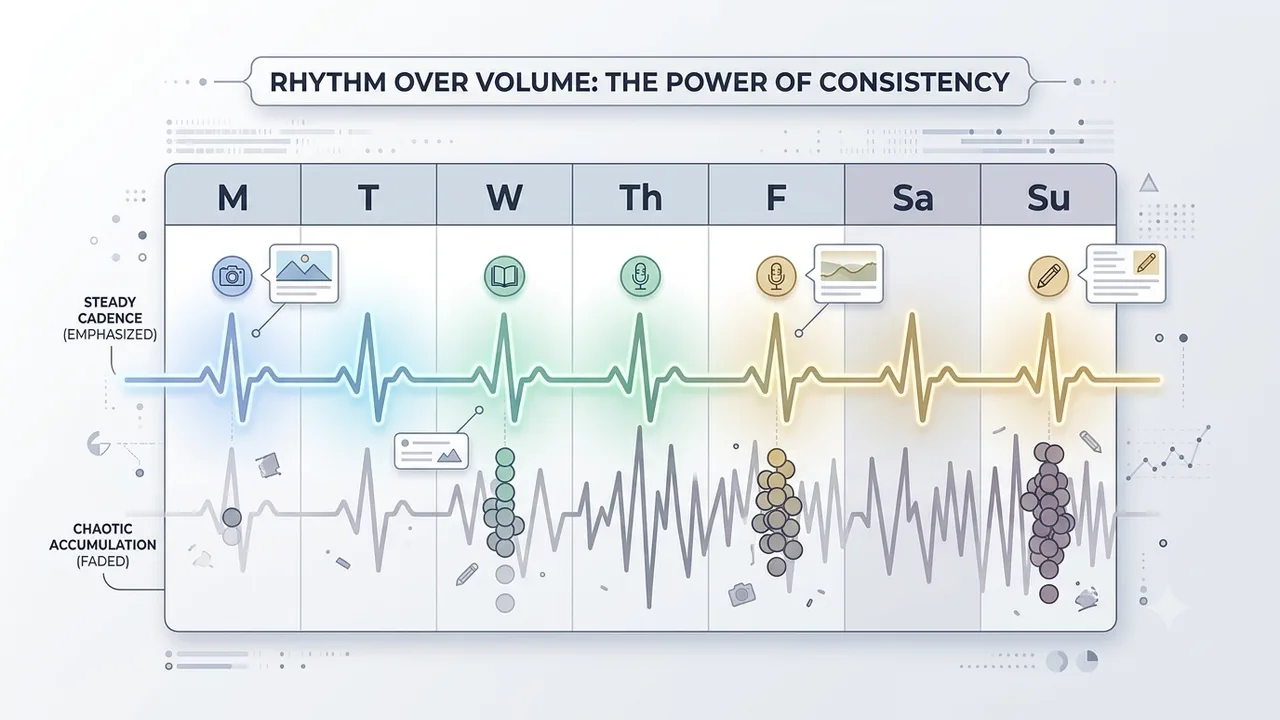
The creators in our dataset who grew fastest were not the ones who posted the most - they were the ones whose posting schedule was most consistent. An account posting 2 tweets per day every day outperformed one posting 10 tweets on three days and nothing for four days.
Consistency matters for two reasons:
- The algorithm rewards accounts with predictable activity patterns - it can better estimate when to surface your content.
- Your audience develops a posting-time expectation. When you show up reliably at the same window, followers build a habit of checking your profile.
How to pick your frequency
A simple decision framework:
- If you are building the habit: Start at 1 tweet per day. Focus entirely on quality and consistency. Do this for 30 days before adding volume.
- If you have been posting for 3+ months: Try 3-5 per day. Mix formats - one original take, one reply, one share with commentary. Track which format type drives your best engagement over 2 weeks.
- If you are an account with 10K+ followers: Test 5-7 per day for one month. Watch your reply rate per post (not total) - if it drops below 50% of your baseline, you are posting too much.
- If engagement has plateaued: The answer almost never is post more. It is usually post differently. Change the format, not the frequency.
Content mix across the day
If you are hitting 3-5 tweets per day, the mix matters more than total count. The format split that worked best in our data:
- 1-2 original takes: Your core insight - an opinion, a lesson, a data point. These drive follower growth.
- 1 thread per week: Longer-form explanation or story. Threads generate 3-4x more saves and shares than standalone tweets.
- 1-2 replies to others: Jumping into relevant conversations boosts your visibility to an audience that does not yet follow you.
- 1 question or poll (occasional): High reply driver. Use sparingly - once per week at most.
Third-party benchmarks
Our findings are broadly consistent with external research. Buffer's 2025 State of Social report found that accounts posting 5-7 times per week on X/Twitter saw the highest average reach-per-post. Sprout Social's 2026 data places peak engagement on Tuesday and Wednesday mornings ET. Hootsuite's benchmark suggests 3-5 posts per day for business accounts, with a note that quality and niche matter more than raw count.
Sources: Buffer State of Social 2025 · Sprout Social Best Times to Post 2026 · Hootsuite Best Times to Post on Twitter 2025. All estimates are aggregated from published third-party reports and our own 90-day cohort study.
TwitFlow tip
Finding ideas for 3-5 daily posts is the hard part, not writing them. The AI tweet ideas generator and the tweet topics database give you a structured way to fill your daily queue in under 5 minutes.